 Noor Al-Banna, CFA, CLP, CVA
Senior Director
Ocean Tomo
Chicago, IL USA
Noor Al-Banna, CFA, CLP, CVA
Senior Director
Ocean Tomo
Chicago, IL USA Juliet Meccia, M.Sc
Data & Patent Analyst
Porta Sophia
Madison, WI USA
Juliet Meccia, M.Sc
Data & Patent Analyst
Porta Sophia
Madison, WI USAThis article explores the critical role of prior art in shaping intellectual property (IP) strategies within biotech, pharma, and the emerging psychedelics sector. It argues that integrating prior art (and related freedom-to-operate) considerations into R&D, patenting, and licensing processes can reduce litigation risks, enhance enforceability, and improve valuations. Special attention is given to how prior art and FTO diligence influences licensing structures - affecting warranties, deal terms, and risk allocation - broadly speaking as well as in contexts involving Indigenous knowledge and social impact. The piece also examines how regulatory frameworks and AI tools intersect with prior art and FTO management, risk assessments, and valuation impacts. Through case studies and data-driven insights, it illustrates the financial and strategic consequences of neglecting prior art and offers recommendations for innovators, investors, and policymakers.
In the high-stakes biotechnology and pharmaceutical industries, and in their emerging offshoots like the fast-growing psychedelics space, patents are both a cornerstone of innovation and a potential latent source of risk. At the heart of this dynamic lie prior art and freedom-to-operate (“FTO”) – distinct but related concepts that are unfortunately often treated as narrow legal formalities, but which in practice exert profound influence across the entire innovation and commercialization lifecycle and affect value. This article explores both concepts in tandem, illustrating how comprehensive diligence is foundational to achieving true FTO in complex innovation landscapes like biotech and psychedelics. In the pages that follow, we will show why we believe that prior art should be reimagined not as just a barrier to patentability, but rather as a strategic consideration that can shape research and development (“R&D”) decisions, inform IP strategy, and impact licensing and ultimately valuations.
Prior art, a foundational concept in intellectual property (“IP”) law, is frequently misunderstood or narrowly construed in practice. At its most basic level, prior art encompasses any evidence that an invention was known or available to the public before the effective filing date of a patent application. IP practitioners are generally familiar with prior art in the form of issued patents, published patent applications, and peer-reviewed scientific literature. However, the legal definition of prior art is considerably broader, extending to publicly accessible disclosures of all kinds, in any language, spanning diverse forms of media. Prior art may also include documented Indigenous practices, traditional knowledge, or community-based teachings that predate modern scientific or commercial development. Despite this expansive definition, prior art searches often remain constrained to conventional databases and familiar sources. Patent and non-patent literature searches frequently prioritize English-language publications and peer-reviewed journals, leaving significant bodies of knowledge unexplored. In fields such as psychedelics, where therapeutic innovation intersects with historic ceremonial, ethnobotanical, and cultural practices, these omissions are particularly consequential. Knowledge that is well known within communities, documented in anthropological records, or shared through nontraditional channels may nonetheless qualify as prior art, even if it falls outside the standard contours of patent examination.¹
✔️Global issued patents and published applications
✔️Peer-reviewed literature and manuscripts
✔️Clinical trials
✔️Product documentation and marketing materials
✔️Traditional knowledge repositories
✔️Social media and online forums
✔️Archival materials
The stakes of comprehensive prior art diligence are especially high in the biotech and pharmaceutical sectors, which are defined by long development timelines, substantial capital investment, and intense competition over sometimes limited areas of scientific novelty. Patent exclusivity often underpins core business models, shaping R&D prioritization, financing, partnering, and commercialization strategies. In traditional pharma, crowded intellectual property landscapes make broad claims increasingly difficult to sustain. Incremental innovation is common, and prior art frequently delineates the outer bounds of patentability. It is apparent then that prior art diligence is not merely defensive but serves as a strategic tool to identify FTO, refine claim scope, and avoid costly research paths that ultimately prove unprotectable. FTO, in turn, refers to the ability to develop, manufacture, and commercialize a product without infringing on the valid intellectual property rights of others. While prior art primarily impacts whether a new invention can be patented, FTO focuses on whether existing patents pose legal barriers to bringing that invention to market.
As referenced above, the psychedelics sector introduces additional complexity, as therapeutic development often draws on substances and practices with extensive known prior use.² Compounds such as psilocybin, DMT, and mescaline have long histories of human use that may be documented in nontraditional sources of prior art, including ethnobotanical records and community-based knowledge. When such sources are overlooked, patent filings risk overclaiming subject matter already in the public domain creating both legal vulnerability and ethical concern. Valid innovation requires careful differentiation from existing knowledge to ensure patentability, legitimacy, and ethical acceptability.
Prior art plays a foundational role in shaping R&D trajectories and downstream patenting strategies, particularly in the innovation-dense biotechnology, pharmaceutical, and psychedelic sectors. With early implementation, comprehensive prior art landscape analysis can inform strategic decisions about which scientific pathways merit investment, and which are likely to be encumbered by existing IP – this is paramount in drug development pipelines where the financial stakes are high. Conversely, when prior art diligence is treated as a narrow, late-stage legal formality, or as an afterthought in the patent application process, organizations risk pursuing crowded or unprotectable innovation spaces, resulting in wasted R&D expenditure and weakened IP portfolios.
From an R&D perspective, early landscape and FTO analyses allow innovators to identify saturation points in the patent ecosystem and pivot toward less congested areas. In the traditional pharmaceutical sector, this is particularly important for small-molecule programs, where decades of family filings often leave little room for broad novelty. In the psychedelic sector, challenges may be different but no less important: cultural, historical, ethnobotanical, and community based knowledge may constitute unpatentable prior art – even if absent from conventional patent databases. Comprehensive diligence in this burgeoning sphere therefore requires expanding beyond standard patent and peer-reviewed literature searches to include nontraditional sources such as foreign-language publications, archival materials, “grey literature,” documented Indigenous knowledge systems, and online forums.
Although these “non-traditional” sources and forms of prior art may initially be unfamiliar to those operating in R&D, such art is valid and accepted by the United States Patent and Trademark Office (“USPTO”) and European Patent Office (“EPO”), and various resources exist to assist innovators and stakeholders to avoid wasting time and money on attempts to develop redundant IP.³
Prior art directly influences patentability determinations, particularly with respect to novelty and non-obviousness.
Claims drafted without full awareness of the prior art risk being rejected during prosecution, narrowed to the point of limited commercial value, or later invalidated through costly litigation. Strategic IP protection increasingly uses prior art proactively to inform claim scope, carving out defensible niches rather than overreaching into broad, invalid territory. This approach often results in narrower but more durable patents that are better aligned with long term enforcement and licensing strategies. At the IP strategy level, prior art awareness supports both offensive and defensive tactics. Offensively, applicants may file targeted claims around identified gaps in the art or pursue continuation strategies that allow inventors to adapt their claims and respond dynamically to evolving landscapes. Defensively, companies may engage in strategic publishing to create blocking prior art, preventing competitors from patenting incremental or ethically sensitive subject matter. This is particularly relevant in fields where “patent thickets” (intentionally dense webs of overlapping parent and child applications) can sometimes create de facto monopolies without corresponding innovation gains.
Forward-thinking regulatory considerations further intersect with prior art strategy in ways that extend beyond patentability. Agencies such as the U.S. Food and Drug Administration (“FDA”) and European Medicines Agency (“EMA”) assess safety and efficacy of a novel compound against the backdrop of existing scientific and clinical knowledge, including prior uses, established mechanisms of action, and risk profiles, even when that information does not contextually qualify as prior art. Strategic awareness of prior art can therefore inform regulatory positioning by helping sponsors anticipate agency expectations, justify reliance on existing data, and streamline development pathways. In this sense, prior art functions not only as a legal constraint but as an evidentiary asset, reinforcing the importance of coordinated R&D, IP, and regulatory planning to reduce redundancy, control costs, and improve the likelihood of regulatory success.
Examples from the burgeoning, yet IP-complex, psychedelics space across various compounds and related technologies demonstrate exactly why gaining a robust understanding of the patent landscape in a specific area is critical before making R&D investment or IP protection decisions. Importantly, and no different than in traditional pharma, it is not just the IP landscape associated with a primary molecule (whether a new chemical entity or a derivative) that is critical to understand. For R&D, investment, patenting, and transactional purposes, companies should gain a robust understanding of the landscapes for related cultivation and extraction methods, formulations, delivery systems, manufacturing methods and processes, methods of treatment, therapeutic settings and protocols, and combinations with other drugs, devices, and even software.
Missing any piece of this chain could result in a false sense of security upon receiving a patent for a specific compound but later running into a web of blocking IP in the complementary technologies necessary to achieve true FTO and have the ability to commercialize.
For example, companies like COMPASS Pathways have pursued traditional patent strategies around crystalline forms of (e.g., US 10,947,257), and treatment methods for (e.g., US 2023/0023092 A1) psilocybin therapies, building patent portfolios to attract capital. However, some of these patents have faced scrutiny regarding prior art given that many psychedelic compounds, and their associated methods of administration and treatment, have extensive historical use and documentation. This reality necessitates even more thorough prior art diligence in licensing negotiations in a burgeoning field such as the psychedelics space with a complex IP landscape.
Recent advances in AI-enabled patent analytics tools have made it possible to conduct contextual searches that go beyond traditional keyword searching, better revealing just how complex patent landscapes can be across different technology dimensions for a single therapeutic. A landscape analysis conducted using Patlytics’ FTO module illustrates this complexity across the psychedelics space and demonstrates why comprehensive, multi-dimensional prior art diligence is essential.⁴
An initial assessment across seven major psychedelic compounds – psilocybin, MDMA, DMT, LSD, ibogaine, ketamine, and 5-MeO-DMT – used contextual searching to identify patents relevant to methods of treating post-traumatic stress disorder (“PTSD”) with each compound as an illustrative example.⁵ The search query format, “A method of treating PTSD comprising the administration of [compound]” was applied consistently across all targets, with synonyms and chemical names included.
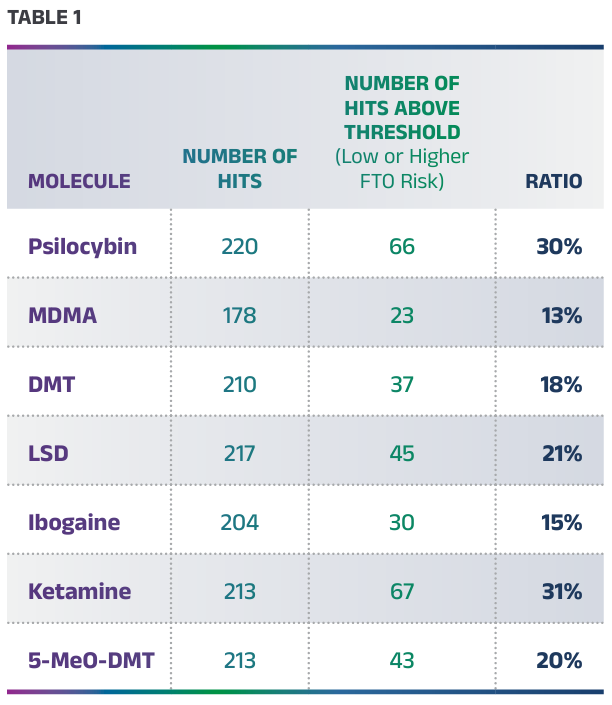
The results shown in Table 1 above revealed comparable activity levels across all compounds, with hit counts ranging from 178 to 220 total results and threshold-meeting results ranging from 13 percent to 31 percent of total hits. The threshold was “low or higher” FTO risk and was selected as a criterion for advanced review of any hits that would be deemed potentially relevant by a practitioner as part of an FTO diligence exercise. Further, this high level analysis may suggest that even for compounds that are not in advanced stages of clinical trials for PTSD specifically (e.g., LSD, 5-MeO-DMT), there is still potentially pertinent patent literature to consider.
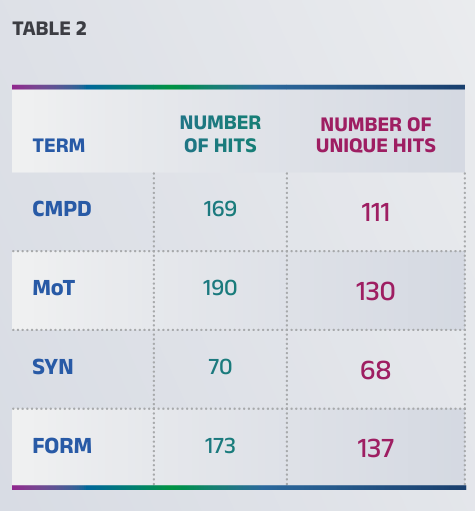
Next, we selected a single drug, 5-MeO-DMT, for deeper analysis. Four separate searches were conducted in Patlytics’s FTO module using the following terms:
Table 2 sets forth the total number of hits for these searches and the number of unique hits for each search. From this data, a correlation matrix was also prepared (Figure 1). For the correlation matrix, the diagonal in the middle represents the total number of hits for each search term. The off-diagonal matrix elements show the number of shared results between search terms.
Across nearly 700 total hits, only approximately 15 percent overlapped between the different contextual searches. This finding is significant in that it demonstrates that the patent landscape for compound claims is largely distinct from the landscapes for methods of treatment, which in turn are distinct from formulation and synthesis patents. Each technology area has its own prior art ecosystem that must be independently assessed.
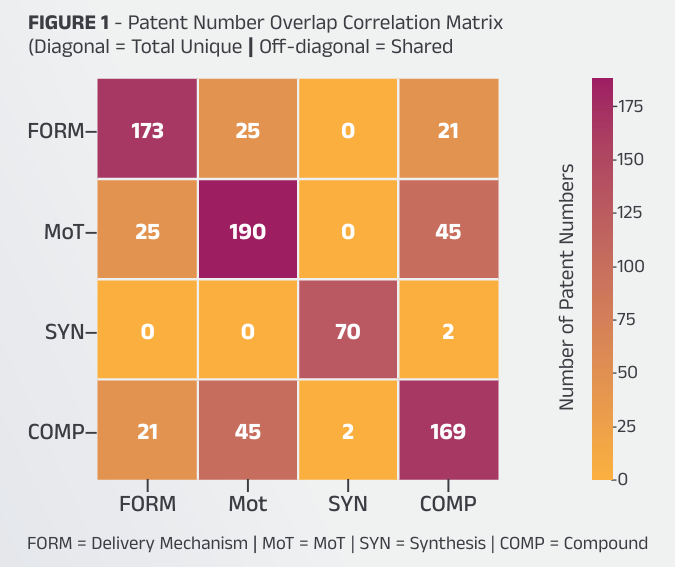
A correlation analysis of the search results revealed intuitive patterns. The composition/method of treatment pair showed the most overlap, which makes sense given that these are often claimed together and represent closely related subject matter. Further, this pairing likely represents a strategic choice for patent applicants, particularly given that pure composition patents on 5-MeO-DMT (first synthesized in 1936 as well as naturally occurring)⁶ face inherent novelty challenges. Method of treatment/formulation showed the second-highest correlation, followed by composition/formulation. Synthesis showed minimal-to-no overlap with formulation and method of treatment – unsurprising given that these subject matter types are typically claimed in separate patent families.
Implications for FTO and Strategic Planning
The practical implications of these findings are significant, and importantly, can be generalized to other compound types. A company developing a 5-MeO-DMT-based therapy might secure a patent covering a novel form or a specific method of treatment and assume they have achieved FTO. They may have also conducted a thorough prior art search on methods of treatment and gained comfort around invalidation risk. However, as this analysis demonstrates, they would still need to navigate largely independent patent landscapes covering formulations, delivery mechanisms, and manufacturing processes – any one of which could present blocking IP that prevents commercialization.
This fragmentation effect is not unique to 5-MeO DMT but applies across the psychedelics space and, more broadly, to traditional pharmaceuticals, biologics, and gene therapies. Therefore, true FTO requires mapping not just the compound landscape but all complementary technology landscapes necessary to bring a product to market.
IP License Structuring & Insurance Implications
Prior art considerations make their way into license agreements most directly via representations, warranties, and indemnification provisions. Licensors may be asked by licensees to provide warranties concerning patent validity, FTO, and non-infringement. While these are often shrugged off as “boilerplate,” the strength, associated risk, and ultimate value impact of these provisions depends substantially on the thoroughness of prior art searches conducted during patent prosecution and pre-licensing due diligence.⁷
In practice, however, licensors in biotech and pharma sectors often seek to disclaim warranties of patent validity, recognizing that sometimes despite best efforts, patents may remain vulnerable to invalidity challenges based on prior art unknown to the patentee.⁸ This reflects the pragmatic reality that even well-conducted prior art searches may not be able to guarantee identification of all relevant art, particularly given expanding searchable databases, many now powered by AI, that now include vast volumes of sources such as non-patent literature, foreign language documents, and even traditional knowledge repositories. Consequently, parties to license agreements increasingly demand comprehensive prior art searches and FTO analyses before executing agreements, shifting due diligence costs upstream with the goal of reducing downstream dispute risks.⁹
The relative bargaining positions of licensors and licensees significantly influence how prior art-related risks are allocated. Licensors who demonstrate robust prior art diligence – including thorough landscape analyses and invalidity opinions on blocking patents – occupy stronger negotiating positions and can resist broader indemnification obligations. Conversely, licensees facing patents with questionable validity due to inadequate prior art searches may demand reduced royalty rates or stronger representations, warranties, and indemnifications.
Prior art considerations also influence whether parties can secure favorable representation and warranty insurance in M&A transactions involving biotech IP assets.¹⁰ Insurers increasingly require evidence of comprehensive prior art searches and validity opinions before providing coverage, recognizing that inadequate diligence increases exposure to invalidity challenges.¹¹
Show Me the Money – Prior Art & Royalties
The risk of prior art is most directly and transparently accounted for in the financial terms of license agreements via royalty stacking provisions. A royalty stacking (or anti-stacking) provision limits the royalty rate payable to the licensor when the licensee is determined to require additional third-party IP to achieve FTO.¹² Studies by LES and RoyaltySource show a range of prevalence of such clauses in life sciences license agreements – although in both cases that share is in the minority, suggesting that the risk of prior art is still not explicitly financially accounted for by the licensing parties in most cases. In the 2024 LES Life Sciences survey (see Figure 2 below), 28 percent of the deals in the sample were determined to have royalty stacking clauses, whereas according to RoyaltySource, 22 percent of the agreements in the biotechnology and life sciences industries mentioned royalty stacking. In both studies, the most common clause was a 50 percent reduction in royalties should third-party IP need to be licensed-in.¹³
Beyond just looking at royalty stacking, RoyaltySource conducted a broader query of its database of biotechnology and pharmaceutical license agreements to identify how many licenses in the field mention FTO or patent validity. The results of that query are shown in the figure below. The universe of agreements included those for both therapeutics and diagnostics, of which therapeutics comprised the majority at almost 90 percent.
The set was also comprised of around an 80/20 split between commercial and non-profit licensors, respectively. Figure 3 below shows the results of the RoyaltySource query.
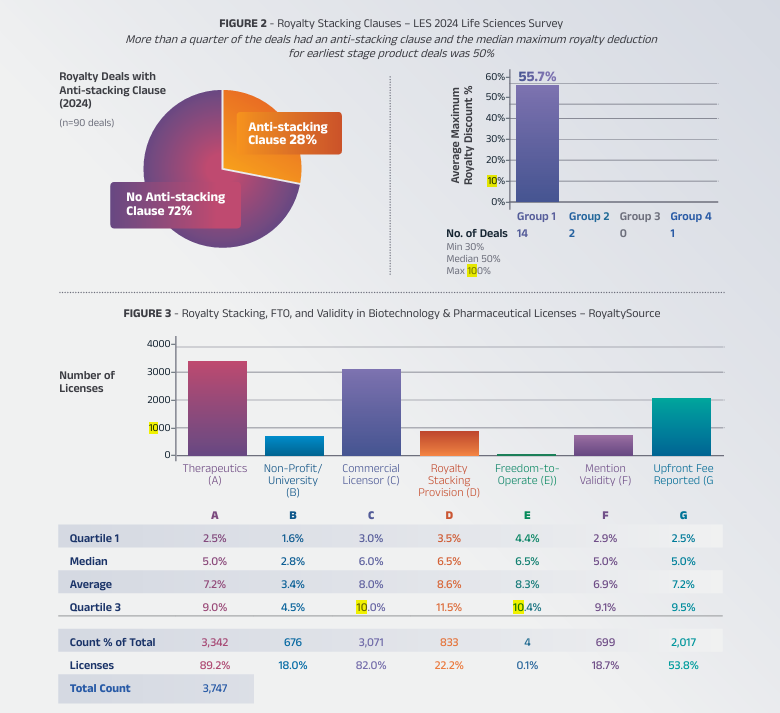
Notably, the licenses that included royalty stacking provisions had higher royalty rates across the board, suggesting that when parties to a deal proactively consider prior art or FTO, they account for the associated risks in the form of higher compensation.
Further, the percentage of agreements that mention validity in some manner (18.7 percent) is close to the percentage of agreements that contain royalty stacking provisions (22.2 percent), although these agreements were not cross-checked to assess the degree of overlap and display different royalty rate statistics, suggesting that while there may be commonalities they are also somewhat distinct. Interestingly, almost none (only 0.1 percent) of the agreements explicitly mention FTO.¹⁴
These findings may underscore a critical disconnect: While prior art and FTO risks are widely acknowledged in theory, they are still not always explicitly addressed in licenses. This could suggest that many deals may be underpricing these risks despite evidence that when such risks are considered, they result in higher royalties.
Impact Licensing
Focusing the lens on the accelerated race towards commercialization of psychedelic therapies, licensing strategies increasingly serve as a critical interface between intellectual property rights and broader social impact objectives. Unlike many traditional pharmaceutical domains, psychedelic innovation is deeply intertwined with longstanding Indigenous, cultural, and community-based practices that may constitute prior art but fall outside conventional intellectual property frameworks.¹⁵ Integrating social impact considerations into licensing therefore requires not only legal diligence but deliberate choices about how innovation-derived benefits are allocated and governed.
Respecting Indigenous rights and knowledge within licensing frameworks begins with acknowledging that many psychedelic compounds and therapeutic paradigms are not novel discoveries but rediscoveries or adaptations of historical and cultural knowledge systems. Licensing agreements that ignore this reality risk perpetuating extractive models of innovation in which cultural knowledge is leveraged for commercial gain without recognition, consent, or benefit-sharing. Social impact–oriented licenses can partially address this imbalance by incorporating mechanisms such as revenue-sharing, research reinvestment commitments, access provisions, or support for community-led health initiatives. While such measures do not resolve broader structural inequities, they signal an effort to align IP exploitation with ethical accountability.
A central challenge, however, lies in the lack of consensus across Indigenous groups and communities regarding ownership, stewardship, and appropriate use of traditional knowledge. Western narratives have relegated diverse and global populations and their knowledge systems into a monolithic mold, ignoring community and cultural differences in practices, governance structures, and views on whether and how psychoactive substances should be used outside ceremonial or traditional contexts.¹⁶ In R&D and licensing discussions, these distinctions are often collapsed into a generalized notion of “Indigenous knowledge,” which can obscure meaningful differences and lead to oversimplified or inappropriate engagement strategies. This lumping effect not only risks misrepresentation but can exacerbate tensions among communities by privileging certain narratives or sources over others.
The consequences of such homogenization and performative actions extend beyond ethical concerns – there are real practical and legal risks at stake. Licensing frameworks built on vague or generalized assumptions about Indigenous consent may face challenges of legitimacy, reputational harm, or resistance from stakeholders whose perspectives were excluded. Moreover, failure to engage with the diversity of Indigenous viewpoints can undermine the credibility of social impact claims made to investors, regulators, or the public. As scrutiny around environmental, social, and ethical practices intensifies, superficial or performative impact licensing may prove counterproductive.¹⁷
The consequences of inadequate prior art diligence are most acutely felt at the enforcement stage. Patent enforceability depends not only on formal validity at issuance but on resilience against later challenges grounded in previously undisclosed or newly surfaced prior art. In both litigation and administrative proceedings, prior art frequently serves as the decisive factor in determining outcomes. From an enforceability standpoint, patents drafted with comprehensive prior art awareness are more likely to withstand validity challenges. Claims that are explicitly distinguished from the known art and supported by robust disclosures create clearer prosecution histories and stronger records. By contrast, patents that ignore or minimize relevant prior art invite aggressive invalidity defenses, undermining their deterrent and monetization value. The financial implications are significant: adverse rulings can eliminate entire patent families, invalidate licensing programs, and trigger cascading effects across portfolios – leading to lost revenues and royalties.
IPR proceedings before the Patent Trial and Appeal Board (“PTAB”) at the USPTO, and inter partes opposition proceedings at the EPO, have further amplified the role of prior art in enforcement strategy. Though recent changes at the USPTO leave the future of IPRs in question,¹⁸ these interventions have historically offered a relatively efficient mechanism for challenging patent validity.¹⁹ In 2025, the USPTO advanced a proposed “settled expectations” framework that would permit discretionary denial of IPR institution where patent owners can demonstrate long-standing reliance interests, such as substantial commercialization or licensing activity tied to an issued patent. While framed with the intention of promoting certainty for mature patents, if utilized this may limit the ability to challenge patents based on newly surfaced or previously overlooked prior art. A predictable consequence of the “settled expectations” framework may therefore shift some validity disputes away from administrative review and into more costly judicial forums.
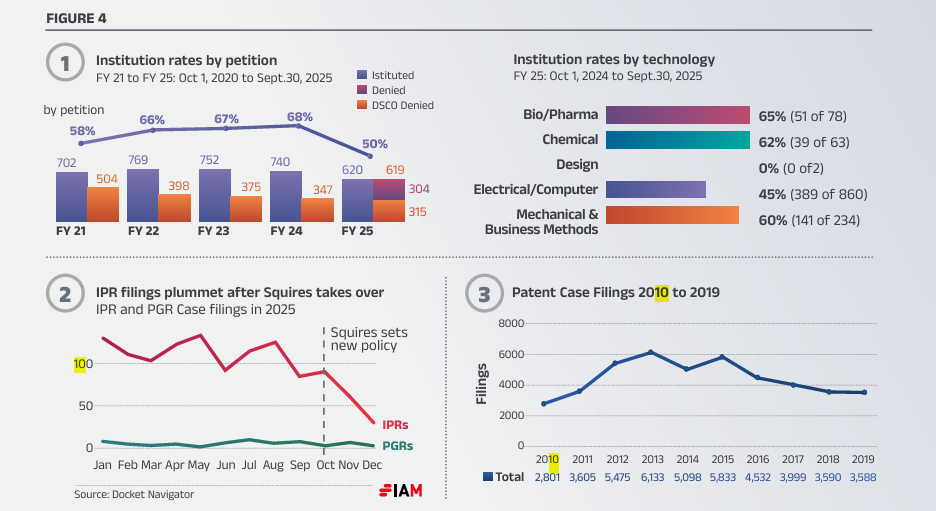
Segment #1 in Figure 4 below shows historical institution rates for IPR petitions, which although historically quite high, already showed significant declines in 2025 due to the USPTO policy changes (seen in Segments #1 and #2), with further declines expected moving forward.²⁰ As shown in Segment #1, biotech and pharma patents have the highest historical institution rate, indicating greater relative invalidation risk. Even when patents survive the IPR impose material burdens on patent holders, often weakening negotiating leverage in parallel litigation or licensing discussions. Segment #3 shows the decline in patent case filings after the passage of the America Invents Act which went fully into effect in 2013 and introduced the IPR.²¹ In light of the current USPTO policy changes, this historical decline could be illustrative of the reversal that may take place over the next few years.
Legendary investor Howard Marks is quoted as saying, “Risk cannot be eliminated; it just gets transferred and spread.” Along the same vein, the first law of thermodynamics states, “Energy can neither be created nor destroyed; it can only be transferred from one system to another or transformed from one form to another.”
Thus, we would propose the following for patent risk: “Patent risk does not vanish, it changes form and venue.”
Additionally, the risk profile is not limited to post-grant proceedings. As a publicly available tool, third-party submissions during patent prosecution increasingly introduce prior art that examiners may have overlooked, reshaping claim scope or prompting abandonment.²² These interventions highlight the systemic limitations of examiner-driven searches and reinforce the strategic value of applicant-led diligence in comprehensive prior art analyses. Emerging legislative and policy developments at the USPTO further complicate the enforcement landscape. Ongoing debates around patent eligibility, validity standards, and PTAB reform signal potential shifts in how prior art is evaluated and weighted. Innovators who fail to anticipate these changes may find their enforcement strategies misaligned with evolving institutional priorities.
Taken together, enforcement outcomes underscore a central thesis of this paper: the costs of ignoring prior art are deferred, not avoided. Investments saved during early-stage diligence are often eclipsed by litigation expenses, lost exclusivity, and reputational damage. Conversely, patents grounded in thorough prior art analysis function as more reliable commercial and strategic assets.
Patent valuation, generally speaking and in life sciences specifically, typically employs three primary methodologies, each susceptible to prior art considerations in distinct ways – we will provide a brief overview of each, followed by a focus on the levers specifically related to prior art and patent validity. Before doing so, however, it is important to understand the situations where in practice patent validity is taken for granted.
The Validity Assumption in Practice
While prior art and patent invalidity represent genuine risk factors that theoretically affect value, in practice many valuation reports and damages analyses proceed under an explicit assumption that the patents at issue are valid, enforceable, and infringed. Understanding where and why this assumption exists – and when it becomes inappropriate – is essential for practitioners relying upon patent valuations in different contexts.
The Litigation Context: Assumed Validity as Legal Doctrine
In patent litigation, the determination of reasonable royalties and damages relies on frameworks such as the Georgia-Pacific hypothetical negotiation construct, which assumes the patents-in-suit are valid, enforceable, and infringed. This assumption reflects where damages determinations fall within the context of patent litigation. By the time a court reaches damages, liability – and therefore validity and infringement – have been established. The following is an example of language one may find in a damages report that explicitly addresses the validity assumption:
Consistent with the legal framework governing reasonable royalty damages, this analysis assumes that the asserted patents are valid, enforceable, and infringed. The hypothetical negotiation construct requires that both the willing licensor and willing licensee are assumed to have considered the patent valid and infringed at the time of the negotiation.
Transactional Contexts: When Assumed Validity May Be Problematic
The litigation assumption of validity may not translate well to transactional contexts such as M&A due diligence, investment decisions, or licensing negotiations. In these settings, the assumption can lead to systematic overvaluation. In a worst-case scenario, the outcome is binary: a patent that may have been valued at $1 million is worth nothing if its claims become fully invalidated. In a situation where claims are partially invalidated, the patent may become worth far less after accounting for the narrowed scope.
The following is an example of language from a valuation report that explicitly addresses the validity assumption:
This valuation assumes that the Subject Patents are valid and enforceable. We have not conducted an independent analysis of, nor are we providing an opinion on, the validity and enforceability of the Subject Patents. No independent legal opinion on patent validity has been obtained or relied upon in preparing this report. The estimated value is contingent upon the patents remaining in-force throughout the forecast period.
Reconciling the Two Approaches
Practitioners should carefully distinguish the purpose of any valuation engagement. For litigation damages reports, the assumption of validity is legally required – experts who discount for invalidity risk may face exclusion for being inconsistent with this presumption. For transactional valuations or strategic assessments, the most rigorous approach involves scenario-based modeling: one scenario assumes the patent is upheld with projected cash flows intact, while alternative scenarios model earlier generic entry or reduced royalty streams following invalidation, each weighted by estimated probability.
Valuation Methodologies & Prior Art
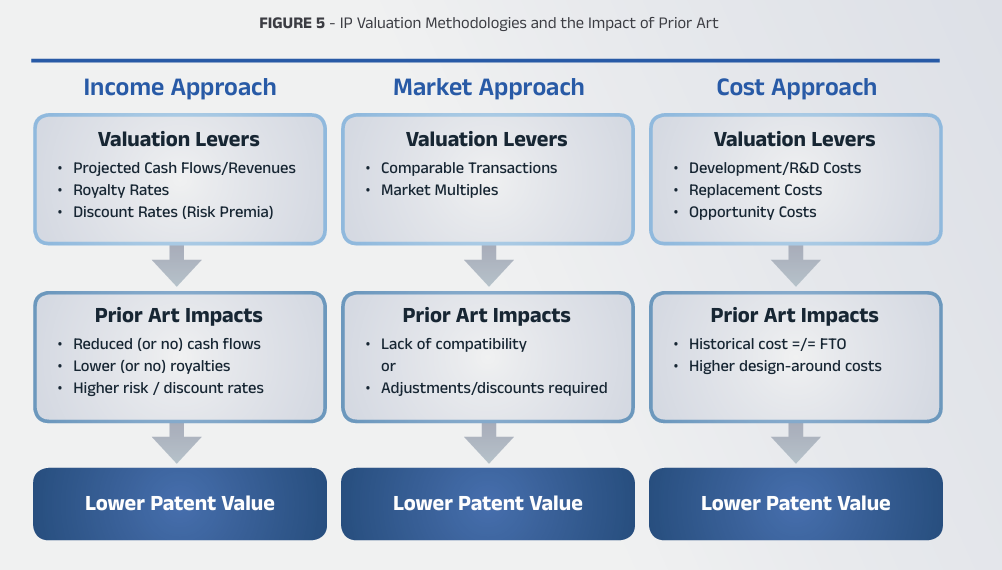
Figure 5 above illustrates the primary valuation levers for each methodology followed by the impact of prior art on each input.
Income Approach
The Income Approach calculates the value of patents based on the present value of future cash flows attributable to the patented technology (also known as a Discounted Cash Flow, or DCF). These cash flows could come in the form of projected profits, license fees, and/or royalties. An important part of the Income Approach is the discount rate, which accounts for the various risks inherent in being able to achieve the projected cash flows, including patent invalidity, among many others. In life sciences valuations specifically, risk is often also accounted for by adjusting the cash flows for the probability of success at each stage of development and clinical trials rather than solely via the discount rate.
Prior art may impact, and be incorporated in, the Income Approach through multiple levers:
Each scenario is then weighted by likelihood based on the patentee or appraiser’s assessment, and the probability-weighted values are summed to arrive at an overall valuation.
Market Approach
The Market Approach calculates value through a review and analysis of comparable transactions involving similar IP assets. The approach involves identifying comparables, collecting data including licensing fees and contractual terms, and creating comparison metrics to estimate market value. In biotech, Market Approach valuations are based on transactions involving similar early-stage drug candidates, including licensing agreements, partnerships, acquisitions, or investments in companies operating within comparable technologies or therapeutic areas. While possible in theory, in practice, explicit adjustments to account for the risk of invalidity are not often made in Market Approach patent valuations. Comparable transactions and licenses are almost always assumed to have been consummated under the presumption of validity, and making accurate adjustments to account for this risk is uncommon.
Cost Approach
The Cost Approach values patents based on past R&D expenditures, patent prosecution costs, and other historical investments. While relatively straightforward, this method has a significant weakness: it ignores the future economic benefits that can be derived from the IP assets. The Cost Approach is instead typically used for verification or to determine minimum price thresholds in negotiations rather than as a primary valuation method. In terms of how prior art impacts the Cost Approach, extensive prior art may necessitate additional R&D expenditures to design around existing patents or to develop sufficiently differentiated products, increasing the cost basis for the valuation.
There is substantial ROI associated with conducting comprehensive prior art diligence as a critical and strategic exercise rather than as a compliance or “check-the-box” one. Quantifying the amounts at issue demonstrates the ROI of proactive prior art diligence – particularly given recent and pending changes to the patent validity challenge landscape, which may dramatically shift the risk calculus.
Upfront Costs of Prior Art and FTO Diligence
For U.S. utility patents, novelty searches have a median cost of $2,500 per patent, while validity opinions are around $10,500 per patent.²³ These figures can be higher for complex biotech technologies requiring specialized expertise. FTO analyses can range from $10,000 – $50,000 on average, potentially rising to $50,000 – $500,000 for comprehensive biotech analyses depending on development stage, geographic scope, and complexity. ²⁴
For a biotech company conducting thorough IP due diligence on a late-stage drug candidate, total upfront costs might reach several hundred thousand dollars. However, when viewed against the hundreds of millions or even billions in costs (see below) – and thus value-at-risk – required to bring a drug to market, even a $500,000 FTO analysis represents only a fraction of the total R&D investment it protects.
Downstream Costs of Inadequate Diligence
The costs of inadequate prior art and FTO diligence dramatically exceed upfront investment. When patents are challenged and found invalid, or if it turns out a company does not have true FTO and is infringing on third-party IP, patentees face multiple direct costs:
Litigation Costs: U.S. patent infringement litigation through trial costs a median of $600,000 when less than $1 million is at stake, rising to $3 million for cases with $10 – 25 million at risk, and beyond $3.6 million when more than $25 million is at issue.²⁵ While costs in Europe are overall lower, they are still substantial and vary widely, ranging from €50,000 – €1,500,000 for single-jurisdiction first instance proceedings, rising into the millions for multi-jurisdictional and second instance proceedings. For the Unitary Patent Court (“UPC”), the Rules of Procedure specify fee caps for reimbursement of legal costs by the unsuccessful party ranging from €250,000 – €2,000,000 dependent on the value of the case.²⁶
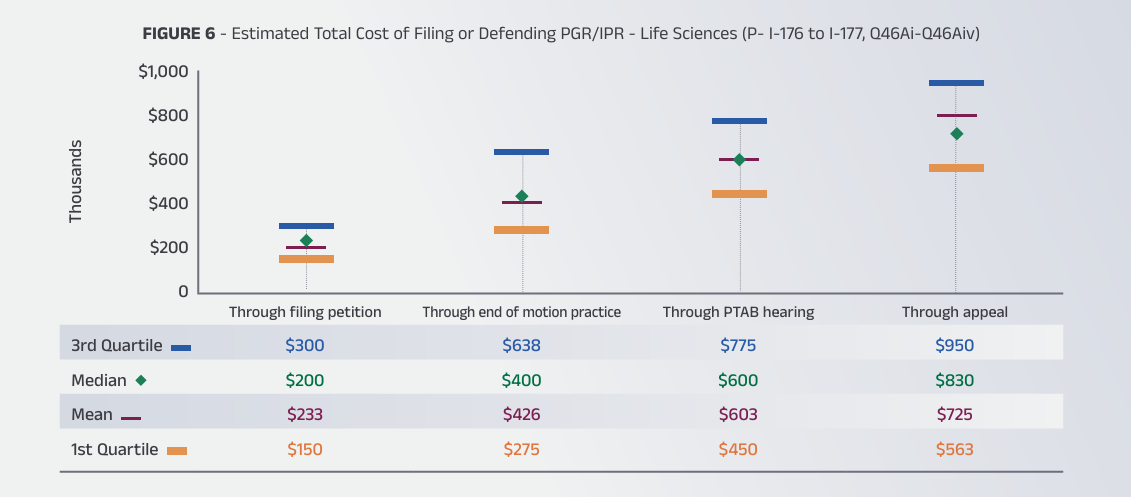
IPR Costs: IPR proceedings for life sciences patents can cost hundreds of thousands or even close to a million dollars if taken through appeal. While cheaper than litigation, IPR institution rates and invalidation rates for challenged claims remain significant risks for patent holders, with much more substantial costs materializing in the form of market exclusivity loss, discussed below.
Loss of Market Exclusivity
By far, the largest cost associated with losing patent protection is the loss of market exclusivity. The “patent cliff” is a dreaded event in the lifecycle of a biotech product where patents expire and generics enter the market. Although not necessarily related to patent invalidity, the amounts associated with the patent cliff can serve as a proxy to understand the magnitude of value loss associated with losing patent protection and market exclusivity. According to Deloitte, Big Pharma faces $236 billion in revenue losses by 2030 as patents expire on 190 high earning drugs, including 69 blockbuster medications generating over $1 billion annually – an average revenue loss of $1.24 billion per drug.²⁷ Small molecule blockbusters commonly see sales plummet 80-90 percent within the first year of generic entry.²⁸ These immense and rapid losses of value can be seen as a proxy for those that may result from eventual patent invalidation.
The Cost-Benefit Calculus
When framed in this light, the ROI of comprehensive prior art diligence becomes overwhelming. Prior art searches and FTO analyses in the tens to hundreds of thousands of dollars protect against millions in average litigation costs and potentially billions in market value loss – representing a rounding error compared to the existential risks they mitigate. Thus, they should be viewed not as a legal expense, but as a high-yield insurance policy on the entire R&D investment.
Case Study #1: The CRISPR Saga
One of the highest profile examples of a prior art dispute in biotech is the long-running and still ongoing CRISPR gene-editing saga, which also has deep impacts on the FTO of users of CRISPR technology in the broader ecosystem. The patent battle between the Broad Institute and the University of California over foundational CRISPR-Cas9 technology has underscored how prior art and inventorship disputes can reshape the commercial landscape of an entire therapeutic modality – and create significant commercial uncertainty. At the heart of the dispute is not only who first invented the use of CRISPR in eukaryotic cells, but also how prior disclosures – both published and unpublished – impact the scope and validity of competing claims. The resulting legal uncertainty continues to complicate licensing, investment, and product development decisions in this space.
The CRISPR case has been discussed at length elsewhere, so here we want to instead emphasize the resulting commercial uncertainty (and value impacts) for licensees and the overall ecosystem that results from the dispute around prior art. From a licensing perspective, companies seeking to develop CRISPR based therapies have had to navigate a fragmented and evolving IP environment, often requiring licenses from multiple parties or risking exposure to infringement claims.
The commercial and valuation impacts have similarly been significant, with the uncertainty surrounding CRISPR IP influencing how companies are valued. The increased frictions, costs, and risks associated with securing licenses to the needed background IP needed for companies in the space to develop new foreground innovations impacts all of the valuation levers discussed above – and all in a negative manner. The CRISPR example reinforces a central thesis of this paper: that prior art and FTO are not abstract legal concepts, but material business risks that can shape the trajectory of innovation, influence capital formation, and determine the ultimate success or failure of a technology platform with commercial value in the many billions that impacts the well-being of millions of people around the globe.
Case Study #2: Diving Into the Known
The psychedelic industry offers a particularly instructive set of case studies illustrating how prior art discovery can lead to markedly different outcomes depending on when and how it is integrated into the patenting process. These examples span proactive diligence, third-party intervention during prosecution, and post-grant challenges, collectively underscoring the strategic and legal consequences of treating prior art as either a foundational input or an afterthought.
In the most constructive scenario, applicants engage in robust prior art diligence early and reflect that analysis transparently in their patent filings. Applicants should use the USPTO’s Information Disclosure Statements (“IDS”) filing system, or follow the EPO’s Rule 141, to submit all prior art relevant to the claimed invention. These systems allow patent examiners to easily access lists of prior art, in theory reducing burden in their own searches. Responsible utilization of disclosure may require tailored claims to avoid covering known compounds, methods of use, or therapeutic contexts disclosed in the prior art – while this strategy can narrow claim scope, it enhances patent credibility and durability by reducing the likelihood of later invalidity challenges. This effective diligence and engagement with the patenting system exemplifies ideal and ethical operation, critical to the psychedelic field.²⁹ However, utilizing disclosure requirements to bury truly relevant prior art has been observed, and some applicants pursuing psychedelic IP file lengthy IDS that may obfuscate prior art. For example, two applications (US 2024/0115549 A1 and US 2024 / 0108601 A1) both claiming 5-MeO-DMT for the treatment of mental health disorders hold lengthy files of continual disclosures, spanning multiple years. This strategy, while technically adhering to requirements of identifying known teachings, increases examiner burden and may ultimately serve to reduce efficacy.
A second set of outcomes arises when relevant prior art is not submitted by the applicant in an IDS nor identified by the examiner but is instead introduced through third-party submissions during prosecution. For example, a 2021 patent application titled “SEXUAL THERAPY FORMULATION AND METHOD OF TREATMENT” (US 2022/0152032 A1) claimed the combined use of sildenafil and MDMA to treat sexual dysfunction – a practice well-known in the psychedelic field. Although the examiner initially allowed the application to proceed, a third party submitted prior art sourced from publicly available harm-reduction and experiential databases documenting the co administration of these substances. This resulted in the patent examiner issuing a non-final rejection of all claims due to lack of novelty, substantiated by the prior art submitted via the third party.³⁰ Faced with evidence that the claimed combination had been previously taught, the applicant ultimately chose to abandon the application.³¹ While this outcome may appear adverse in isolation, it illustrates the corrective function of third-party participation in the patent system and highlights the risks applicants assume when prior art searches fail to extend beyond traditional databases.
The most consequential outcomes occur when relevant prior art surfaces only after a patent has been granted. In these cases, newly identified references may form the basis of IPR proceedings, reexamination requests, or invalidity defenses in litigation. For psychedelic patents, post-grant challenges often draw on historical use, community knowledge, or nontraditional publications that were not considered during examination. When successful, these challenges can result in partial or total invalidation of granted claims, undermining not only the patent itself but also any licensing, enforcement, or valuation strategies built upon it.
Taken together, these case studies demonstrate that prior art discovery is not a singular event but an ongoing process with consequences that evolve across the patent lifecycle. Proactive engagement with prior art tends to produce narrower but more resilient patents, while reactive or delayed discovery often leads to rejection, abandonment, invalidation through litigation, or value erosion. In the psychedelic industry, where non-traditional sources of knowledge are especially diverse, the stakes of getting this balance right are particularly high.
The lessons from both traditional biotech and pharmaceutical industries as well as the emerging psychedelic sector converge on a clear takeaway: prior art must be treated not as a procedural hurdle, but as a foundational strategic consideration. Whether at innovation inception, the interim processes of R&D investment and patenting strategy, or the final stages of licensing, valuation, and enforcement, the presence (or absence) of robust prior art diligence and true FTO can determine the trajectory of an asset’s commercial viability. In a world where the all-in costs of invalid patents can reach into the billions, early and expansive prior art analysis and FTO diligence is not merely prudent – it is essential.
In novel, high-potential therapeutic areas across the biotech space, of which psychedelics are a prime example, the stakes of not having true FTO are massive, and frankly unsustainable, for patentees, investors, and society. The path forward demands a shift in mindset from reactive to proactive, from narrow to inclusive, and from compliance to strategy. Part of this strategic thinking is understanding how patent validity and FTO translate into value. Keeping the levers of valuation in mind throughout the process helps practitioners understand the ultimate potential commercial impacts of the technical and legal analyses they are doing and keeps them from devolving into abstract or merely compliance-driven exercises.
With increasingly sophisticated AI-driven patent analytics and search tools becoming widely available and better by the day, there is even less of an excuse for failure to thoroughly and strategically analyze prior art and FTO. Innovators who embrace this mindset will be better positioned to build durable, defensible, and ethically grounded IP portfolios that can withstand legal challenges, attract investment, and deliver long-term sustainable value for all.

 Latest Articles Of The Month